







Violino di Capra: history and origins of Valle Spluga’s traditional cured meat
From the traditions of Valle Spluga to the Crotti of Valchiavenna: the history, production and fascinating facts behind the goat’s leg cured meat recognised as a Slow Food Presidium
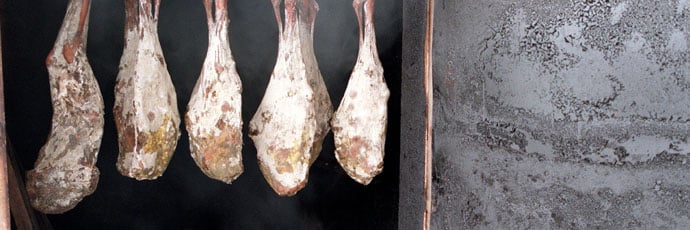
Violino di capra is a traditional cured meat from Valle Spluga, made from a goat’s hind leg or shoulder, salted, seasoned and aged for 3–6 months. Its name, which translates as “goat’s violin”, refers both to its shape and to the traditional way it is sliced: held against the shoulder, with the knife moving like a bow across violin strings. It is a Slow Food Presidium and one of the most distinctive specialities of Valle Spluga.
Behind this unusually shaped cured meat lies a long tradition of goat farming and ancient meat-preservation techniques, such as those practised in the crotti of Valchiavenna. These natural rock cavities have a distinctive microclimate that has favoured the ageing and preservation of food for centuries.
What is Violino di capra?
Violino di capra is a cured meat that is not stuffed into a casing. Instead, it is made from a whole anatomical cut of the animal, either the hind leg or the shoulder, which retains its natural shape throughout the production process.
The cuts are generally relatively small: around 2 kg for the shoulder and up to 3.5 kg for the hind leg. The meat is salted and seasoned, then left to age slowly according to techniques passed down through local tradition.
Why is it called Violino di capra?
The name first refers to the shape of the cured meat: the leg resembles the neck of a violin, while the meatier section evokes the instrument’s body.
There is also a second, even more curious explanation: the way it is sliced. Traditionally, the Violino is held against the shoulder and sliced by hand in a movement resembling a bow being drawn across the strings. According to local tradition, the name was coined in 1930 by Giovanni Bertacchi, a poet from Chiavenna, who was struck by the gesture used to slice the meat. It is important to note that this is a traditional description of the technique, not a recommendation to slice the Violino in this way.
Where does Violino di capra originate?
Violino di capra is closely associated with Valchiavenna and, in particular, Valle Spluga, where the tradition developed over time, partly thanks to goat farming in the mountain areas. Today, the traditional production area recognised by the Slow Food Presidium includes the province of Sondrio, the municipality of Chiavenna and the whole of Valle Spluga.
Goats were particularly well suited to the mountain economy: they could graze on difficult terrain and provided both milk and meat. The need to preserve meat for longer periods led to the development of salting and ageing techniques that can still be recognised in the Violino produced today.
How is Violino di capra made?
The process begins with the selection of the goat’s hind leg or shoulder. The meat is then salted and seasoned with garlic, spices and herbs, with red wine also added, before being left to age.
The Slow Food Presidium’s production guidelines place particular emphasis on goats raised using semi-free-range farming methods in the mountain areas of the province of Sondrio, with a diet that also draws on local resources.
The natural shape of the cut is deliberately preserved throughout the process. This is precisely what distinguishes Violino di capra from conventional cured meats made by stuffing meat into casings.
How long is it aged, and what role do the crotti play?
Traditional Violino di capra is aged for between 3 and 6 months, preferably in specially selected crotti or similar traditional ageing spaces, which provide particularly suitable conditions for preserving meat.
Crotti are natural cavities among the rocks, characteristic of Valchiavenna. Inside them, a natural airflow known as the sorel circulates, keeping the temperature at around 8°C and creating favourable conditions for food preservation.
For centuries, crotti served as a kind of natural pantry: a place where cheeses, cured meats and other local products could mature slowly.
Is Violino di capra a Slow Food Presidium?
Yes. Violino di capra from Valchiavenna has been a Slow Food Presidium since 2000. The Presidium safeguards traditional production methods and the connection with goat farming in the mountain areas of the province of Sondrio.
This recognition has helped preserve an artisanal tradition that was at risk of becoming increasingly rare, while highlighting the close relationship between the cured meat, the local landscape and goat farming.
How is Violino di capra sliced and served?
Violino di capra is traditionally sliced by hand, with the meat resting on a chopping board, producing thin slices from the outer surface. The traditional, though not recommended, technique of holding the Violino against the shoulder is the gesture that, together with its shape, explains the cured meat’s unusual name.
It is generally served in thin slices, accompanied by rye bread and red wine. It can also be enjoyed alongside other traditional products from Valchiavenna, including local cheeses and regional specialities.
Why is Violino di capra important to Valle Spluga?
Violino di capra tells the story of an age-old way of life in the mountains: raising goats, preserving meat, making use of the crotti and transforming the resources available into food that could be stored over time.
Its origins are simple, yet its identity is unmistakable. This strong connection with the local area has allowed the tradition to survive to the present day, making Violino di capra one of the signature products of Valle Spluga and Valchiavenna.
Frequently Asked Questions about Violino di capra
Is Violino di capra a cured meat?
Yes. It is a cured meat, but it is not stuffed into a casing. It is made from a whole goat’s hind leg or shoulder.
How much does a Violino di capra weigh?
The shoulder typically weighs around 2 kg, while the hind leg can weigh up to approximately 3.5 kg.
How long is it aged?
Traditional ageing generally lasts between 3 and 6 months.
Why is it called Violino?
The name refers to its violin-like shape and to the distinctive hand-slicing movement, which resembles the movement of a bow across violin strings.
Where does Violino di capra originate?
It is a speciality particularly associated with Valle Spluga. The production area recognised by the Slow Food Presidium includes the province of Sondrio, the municipality of Chiavenna and the whole of Valle Spluga.